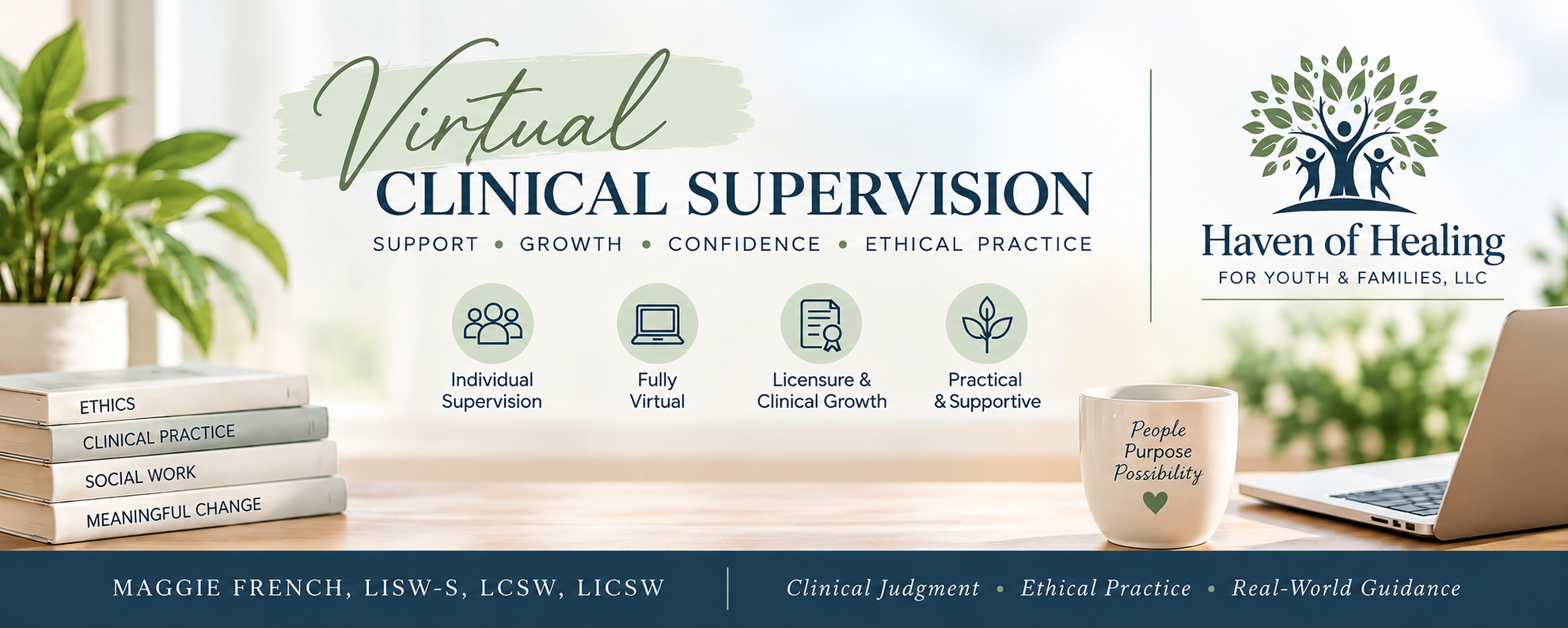
Clinical Supervision for Social Workers
Supportive. Practical. Collaborative. Direct.
Virtual clinical supervision for eligible social workers in Ohio, Indiana & Vermont
Supervision isn't about having all the answers—it's about learning to ask better questions, trust your clinical judgment, and grow into the clinician you want to be.
I often tell supervisees and clients
“You only know what you know until you know, you know?”
It usually gets a laugh, but there's a lot of truth behind it. None of us enters this profession knowing everything. Supervision is where we figure out what you already know, identify what you don't know yet, and build the knowledge and confidence to keep growing.
Supervision Should Be More Than Checking a Box
Yes, supervision may be part of meeting requirements toward independent clinical licensure.
But if all we're doing is accumulating hours, we're missing the point. I believe supervision should be a place where you can bring complicated cases, uncomfortable questions, documentation you're not quite sure about, and those inevitable:
“Am I doing this right?”
moments without feeling like you're supposed to already have everything figured out.
One of my biggest priorities as a supervisor is helping clinicians learn to trust their clinical judgment. You can know the diagnostic criteria, understand the theory, and have plenty of interventions in your toolbox—and still second-guess yourself.
Clinical confidence develops through experience, reflection, feedback, asking questions, making mistakes, and discovering that you often know more than you think you do.
What We Can Work On in Supervision
Your supervision should reflect your experience, practice setting, clients, professional goals, and where you are in your development as a clinician.
Assessment, Diagnosis & Case Conceptualization
Strengthening assessment skills, differential diagnosis, case conceptualization, and your ability to explain not only what you're seeing clinically, but why you're making the decisions you're making.
Clinical Skills & Difficult Cases
Talking through cases that feel stuck, treatment approaches, therapeutic relationships, challenging dynamics, trauma-informed practice, family systems, substance use and co-occurring concerns.
Treatment Planning & Documentation
Connecting assessment, medical necessity, treatment goals, interventions, progress, and documentation—while developing documentation practices that are clinically meaningful and sustainable.
Ethics, Boundaries & Professional Practice
Working through ethical dilemmas, confidentiality, mandated reporting, professional boundaries, countertransference, telehealth considerations, and situations where the answer isn't always obvious.
Risk Assessment & Safety Planning
Building confidence with suicide and self-harm assessment, safety planning, documentation, clinical decision-making, and determining when additional intervention is necessary.
Professional Identity & Clinical Confidence
Developing your own therapeutic style, recognizing your strengths, identifying areas for continued growth, receiving feedback, and becoming increasingly comfortable making sound clinical decisions.
My Approach to Supervision
My job isn't to make clinical decisions for you.
It's to help you develop the knowledge, skills, and confidence to make sound clinical decisions yourself.
Real-World Clinical Supervision
My supervision style is supportive, collaborative, practical, and direct. I don't expect you to walk into supervision with all the answers—that's why supervision exists. I do expect curiosity, openness to feedback, ethical practice, accountability, and a willingness to grow.
We'll talk about what went well, what didn't, what you're unsure about, and what you might do differently next time.
I also don't want you to become dependent on supervision to feel confident in your decisions.
The goal is for you to develop your own clinical voice, recognize what you know, recognize what you don't know, know when to seek consultation, and become increasingly comfortable trusting your professional judgment.
Graduate school gives you the foundation. Clinical practice is where things tend to get more complicated.
Being both a clinician and co-owner of a multidisciplinary behavioral health practice allows me to bring the realities of everyday behavioral health work into supervision—not just textbook concepts.
We can talk about:
Documentation • Difficult Cases • Ethical Dilemmas • Managed Care • Telehealth • Professional Boundaries • Interdisciplinary Collaboration • Risk Management • Private Practice • Clinical Decision-Making
And all those messy situations that somehow didn't come with a chapter explaining exactly what to do.
Areas of Clinical Experience
My clinical experience includes working with children, adolescents, adults, couples, and families across a range of behavioral health concerns. Areas I can bring particular experience to supervision include:
Trauma & PTSD • Anxiety • Depression • ADHD • Grief & Loss • Substance Use & Recovery • Co-Occurring Disorders • Relationship & Family Concerns • Parenting • Divorce & Family Transitions • Domestic Violence • Life Transitions • Stress & Burnout • Women's Issues • Career & Professional Concerns • Child & Adolescent Mental Health
My clinical approach incorporates CBT, Cognitive Processing Therapy, Narrative Therapy, Motivational Interviewing, Solution-Focused Brief Therapy, strengths-based and person-centered approaches, family systems, psychoeducation, mindfulness-based interventions, and trauma-informed care.
States & Licensure
I hold independent clinical social work licenses across multiple states and provide virtual supervision for eligible social workers in following States:
Ohio
Maggie French, LISW-S
Clinical supervision for eligible Ohio social workers when the proposed supervision arrangement meets Ohio licensing requirements.
Indiana
Maggie French, LCSW
Clinical supervision for eligible Indiana social workers when the proposed supervision arrangement meets Indiana licensing requirements.
Vermont
Maggie French, LICSW
Clinical supervision for eligible Vermont social workers when the proposed supervision arrangement meets Vermont licensing requirements.
Supervision requirements vary by state, license type, employment setting, and the purpose of supervision. Before beginning licensure-focused supervision, we'll review your current license, practice setting, goals, and applicable requirements to determine whether I can provide the supervision you need.
Rates & Supervision Options
Choose the type of support that fits where you are professionally.
INDIVIDUAL CLINICAL SUPERVISION
$125 | 60 Minutes
One-on-one virtual clinical supervision for eligible social workers working toward independent clinical licensure.
Supervision is individualized to your experience, clinical work, professional development, and applicable licensure requirements. Depending on your needs, our work may include assessment and diagnosis, case conceptualization, treatment planning, clinical documentation, ethics, risk assessment and safety planning, boundaries and countertransference, difficult cases, telehealth, and developing confidence in your clinical decision-making.
My goal isn't to tell you exactly what to do or to create a clinician who practices exactly like I do. It's to help you strengthen your clinical judgment, understand the reasoning behind your decisions, recognize when consultation is needed, and develop your own clinical voice.
Virtual individual supervision is available to eligible social workers in Ohio, Indiana, and Vermont.
Schedule a Supervision Consultation
Best for: Eligible social workers working toward independent clinical licensure who want individualized, consistent supervision.
Employer-Sponsored Supervision
If your employer provides or reimburses the cost of external clinical supervision, employer-sponsored arrangements may be available.
Before supervision begins, we will clarify the supervisory relationship, payment arrangement, documentation requirements, confidentiality and its limitations, communication with the employer when applicable, and the respective responsibilities of the supervisor, supervisee, and organization.
PROFESSIONAL CLINICAL CONSULTATION
$150 | 60 Minutes
Already independently licensed but occasionally find yourself thinking, “I need to talk this through with another clinician”?
Professional clinical consultation provides a confidential space to think through complex clinical and professional situations with another experienced clinician.
Consultation may include difficult or complex cases, diagnostic considerations, treatment planning, documentation, ethical questions, risk assessment and safety planning, boundaries and countertransference, telehealth, managed care, private-practice concerns, or other situations where another clinical perspective may be helpful.
You don't have to be unsure of yourself to benefit from consultation. Sometimes good clinical judgment includes recognizing when another perspective would be useful.
Professional consultation is not clinical supervision, does not count toward licensure supervision requirements, and does not establish a supervisory relationship.
Payment & Scheduling
Clinical supervision and professional consultation are private-pay professional services and are not billed to health insurance.
Supervision is provided virtually by appointment. Ongoing supervisees may establish a regular schedule based on supervision requirements, professional needs, and availability.
Because supervision requirements vary by jurisdiction, license type, employment setting, and the purpose of supervision, we will review your current license, state of practice, employment setting, professional goals, and applicable licensing requirements before establishing a formal supervisory relationship.
Payment is due at the time of service unless an employer-sponsored payment arrangement has been established in advance.
Who May Be a Good Fit
We may work well together if you:
Want more from supervision than simply accumulating required hours
Want to strengthen your clinical judgment rather than be told exactly what to do
Appreciate a supervisor who is supportive and direct
Want to improve your assessment, diagnosis, treatment planning, or documentation
Want somewhere to bring difficult cases and uncomfortable questions
Are open to feedback, reflection, accountability, and continued learning
Want to develop your own clinical voice rather than imitate your supervisor
Occasionally find yourself thinking, “Am I doing this right?”
About Maggie
I’m a clinician and co-owner of Haven of Healing for Youth & Families, LLC, a multidisciplinary, multistate behavioral health practice serving children, adolescents, adults, couples, and families. But long before I became a practice owner, I was a social worker trying to figure out how everything I learned in school actually translated into sitting across from a real person and being responsible for helping them.
And the longer I do this work, the more convinced I am that good clinical practice isn't about having all the answers.
I often tell supervisees, “You only know what you know until you know, you know?” It usually gets a laugh, but I genuinely believe it. None of us comes into this profession knowing everything—and experience doesn't suddenly change that.
To me, becoming a more experienced clinician means getting better at recognizing what you know, what you don't know, and what to do when you don't know. Sometimes that's research. Sometimes it's another training. Sometimes it's consultation. And sometimes it's simply being able to say, “I don't know, but I'm going to find out.”
I've worked with children, adolescents, adults, couples, and families across a wide range of clinical concerns, and being both a clinician and practice owner has given me a front-row seat to the parts of behavioral health that don't always make it into a textbook.
Because clinical work doesn't happen in a textbook.
It happens when you're staring at a progress note wondering whether you documented enough—or too much. When the diagnosis isn't as clear as the criteria made it sound in grad school. When you're balancing what a client needs with insurance requirements, ethical responsibilities, professional boundaries, risk decisions, family dynamics, and all of those situations where the answer seems to be, “Well...it depends.”
Those are the conversations I think belong in supervision.
At Haven of Healing, one of the things that matters deeply to me is remembering that behind every diagnosis, treatment plan, progress note, assessment, and clinical decision is a human being who has trusted us enough to allow us to join them on part of their journey.
Yes, I want the clinicians I supervise to know how to assess, diagnose, document, treatment plan, recognize risk, understand ethics, and make sound clinical decisions. Those things matter. But I don't ever want us to become so focused on doing everything clinically correct that we forget why we're doing it in the first place.
Developing strong clinicians means building the technical skills to do this work well without losing sight of the human being those skills are meant to serve.
Ultimately, I don't want you to become a clinician who practices exactly like I do.
I want you to become your kind of clinician—your own “Jack of all trades, master of none.” Knowledgeable. Ethical. Curious. Confident enough to trust your judgment, humble enough to recognize when you don't know something, and comfortable enough to ask for help when you need it.
Not because expertise doesn't matter—it absolutely does. But behavioral health is enormous, as is our profession. There will always be something else to learn, a situation you haven't encountered, or a question you don't immediately know how to answer.
None of us ever gets to the point where we know everything. We just keep learning what we didn't know yesterday.
And, well...
“You only know what you know until you know, you know?”
Stay curious.
Never stop learning.
And never ever forget your purpose.